
Neospire®
Stopping slips,
before they happen.
We quantify footwear slip risk so you can make an informed decision.
Why footwear matters
The right shoe can reduce slip risk dramatically—from a liklihood of slips being 1 in 2 down to 1 in 1,000,000 or better!
The wrong shoe? It can make things worse, undermining the other control measures you already put in pace.
But how do you know which shoes to buy?
Footwear Buyers - Know the risk
If you’re buying footwear for staff or advising on control measures, the single most cost-effective thing you can do to reduce slip risk is avoid shoes that don’t perform and buy ones that do. In most cases the change is at zero net cost, simply assess the range of shoes you currently buy and then reduce the selection to the ones that give a slip risk you are happy with - and which eliminates accidents.
If your staff are having slips, footwear is a very practical solution. Our work has shown that even as an entirley new cost, where footwear was not previously provided, footwear is cost effective in preventing slips, injuries and claims.
“Safer shoes mean zero slips, zero litigation.”
NHS litigation data show that slips and trips have cost over £126 million in damages and legal fees in the past decade, averaging £12.6 million every year. The SSHEW study explains why: almost 90% of everyday shoes in the control group were poor performers (HSE GRIP <3), leaving staff at high risk. By contrast, when participants wore intervention footwear (all HSE GRIP ≥3), no slips occurred. Every accident in the intervention arm happened only when staff failed to wear the provided shoes. The evidence is clear: the right footwear doesn’t just reduce slips — it eliminates them, along with the costly litigation that follows.
Streamlined testing procedure to establish slip risk on flooring contaminated with water contamination, uses a smooth ceramic surface, which makes for a challenging combination representing the majority of slip accident scenarios:
Four outcomes of slip risk reported:
Very High Risk
High Risk
Moderate Risk
Low Risk
Great for taking stock of risk exposure from current footwear selection and making decisions on future purchasing.
Footwear Slip Resistance Testing
Using our validated bench-top tribometer
Streamlined testing procedure to establish slip risk on flooring contaminated with grease or oil, uses a smooth ceramic surface with 80% Glycerol solution, as a challenging high-viscosity contaminant:
Four outcomes of slip risk reported:
Very High Risk
High Risk
Moderate Risk
Low Risk
For those working in challenging conditions, this adds to the basic wet assessmnet, building up a better picture of the overall slip risk. Ideal to ensure current footwear selection is appropriate and for making decisions on future purchasing.
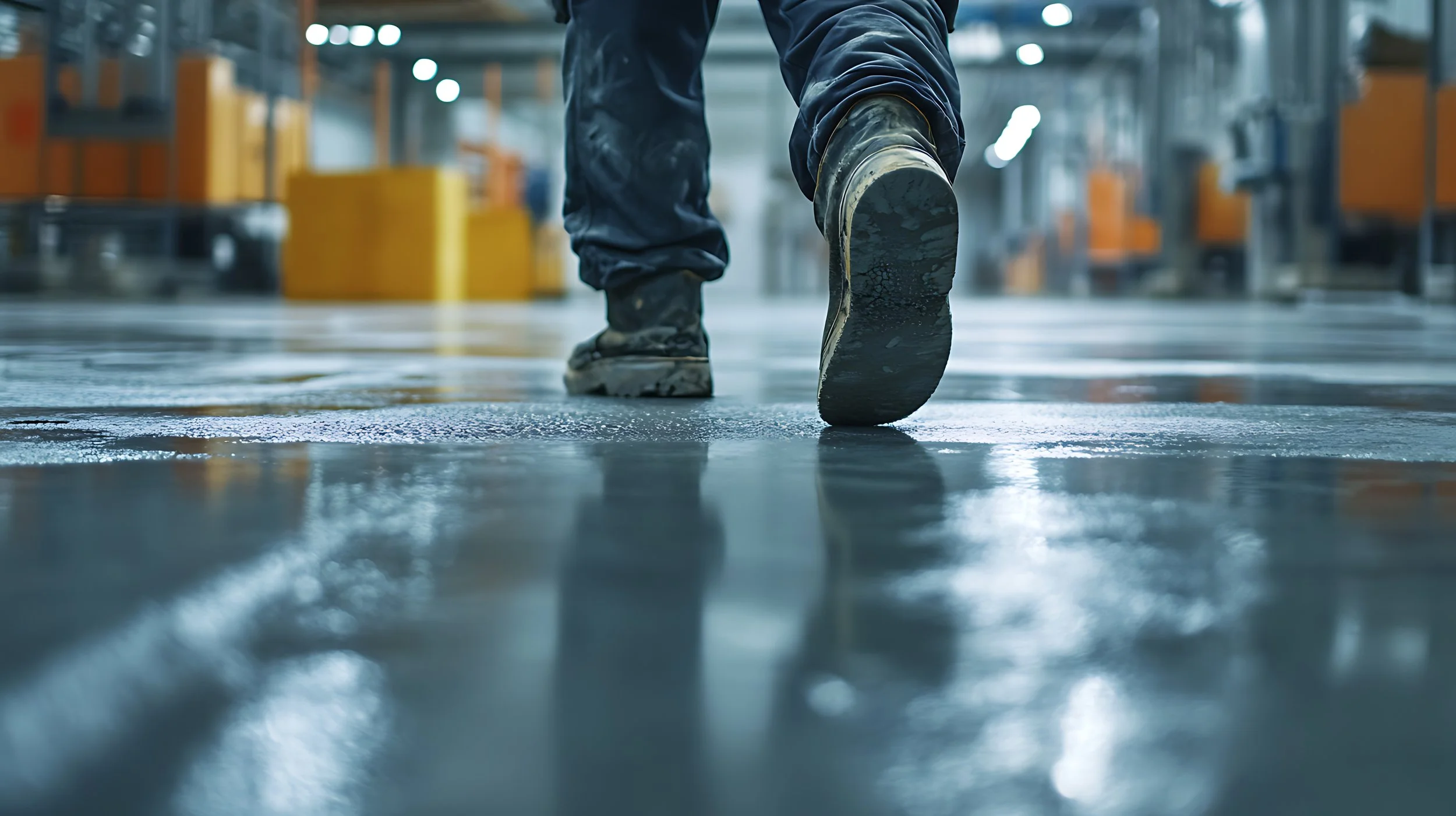
Comprehensive testing procedure to establish coefficient of friction on smooth wet flooring:
Two outcomes of slip risk reported:
Coefficient of Friction with water contamination
Coefficient of friction with 80% Glycerol solution contamination
Report explains friction and relates this to slip risk, based on reliable biomechanical data.
Great for product development and for risk assessment in more challenging environments.

Comprehensive testing procedure, to establish the coefficient of friction, plus DMTA on the soling material and 3D scan of the tread.
Package is intended to inform product development, gaining insights into the material characteristics and the design of the tread pattern. Routine collection of the full suite of data will inform future product deisgn. DMTA allows sellers to identify changes in material properties that creep over time, allowing any changes in slip performance to be understood.
We can look at chellenging conditions, for instance where the working environment spans a wide temperature range, i.e. will the shoes continue to work sub-zero?
Why today’s standards won’t save you

The description “slip-resistant” on labels doesn’t mean what you think.
Standards represent a minimal threshold that everything achieves, and the test used is poor. Using this approach means all footwear is labelled as ‘slip-resistant’.
Same description but completely differently performance when you need it most.
You can get anything from 1 in 2 people slipping to 1 in 1,000,000 people slipping - it really is that uncertain.
That’s why “slip-resistant” doesn’t usually mean slip-safe.
At Neospire, we cut through the noise. Our high-fidelity testing shows you exactly how footwear grips—or fails—in the conditions that cause injuries. No marketing fluff, no false confidence. Just hard data you can trust.
Slip-resistant on the label might mean one of the two people at the front slipping, or just one person from the whole crowd
Neospire is led by Kevin Hallas, former Technical Lead for Falls Prevention at the UK’s Health & Safety Executive. With a career dedicated to reducing slips, trips and falls, Kevin brings a unique mix of scientific rigour, regulatory insight, and practical know-how to the challenge of footwear safety.
His interest in how footwear interacts with the floor—materials, tread patterns, and the hidden science of friction—sparked the creation of Neospire and its mission to improve grip and reduce injuries worldwide.
Kevin’s work has been recognised by the Royal Academy of Engineering, where he was awarded a place on the Regional Talent Engine, supporting innovators who tackle real-world engineering problems with cutting-edge technology.
At Neospire, that mission is simple: turn complex tribology into practical solutions that safety professionals, manufacturers and test labs can trust.
Who we are

Contact Us
If you’re concerned about slips in any footwear, you’ve come to the right place… Let’s talk…
Fill out some info and we will be in touch shortly. We can’t wait to hear from you!